Something New, Something Old
An eventful week.
We escaped the Midwest for a few days to enjoy some sun, heat, and sand. Naturally it was quite warm in Indianapolis a couple of the days we were gone, and in the 40s when we returned. Such is life in the Midwest in March…
While we were away I at long last received a new callsign. For various reasons, I moved the call I applied for back in January down to the third spot on my latest application. Two other operators applied for it on the same day, so I don’t know that I would have received it had it been #1.
I did get my new first choice, though. I am now N9KM. More on that soon.
Why did I change from one vanity call, that was only three months old, to a new one? Well, as pleasing as KC9DD is to the eye - it is really fantastic to look at - it gave me issues on the air. That double D threw people. I forced myself to speak a little more slowly than normal, and enunciate those D’s as clearly as I could. But at least once a day, and much more during contests, I would get asked to repeat my suffix, or be asked “was that Alpha Delta?” or some other combo that was not Delta Delta. Nothing worse during a contest weekend than having to say your call multiple times.
During the ARRL International DX contest it seemed like I was saying “Denmark Denmark” every third or fourth contact in an attempt to clarify. One op in Alaska was really thrown when I switched to the alternate phonetic and simply gave up and moved on.
In addition to the problematic double D, on busy days it seems like there are dozens and dozens of KC9 stations out there. While I’m partial to the KC prefix since I am originally from Kansas City, I figured if my goal was to be more understandable, why not drop the Kilo prefix too?
That’s how I ended up with N9KM. Hopefully the switch was worth the wait and helps my voice slice through the pileups a little easier. I’ve given the FCC enough money the last five months, I have no desire to go through the process again.
I got my antenna elevated again Sunday. As expected it was a bit of a hassle. It is an end-feed wire that runs from an old, dying oak tree next to our house to a massive spruce on the edge of our property. This spruce is ancient and gnarled. There are lots of dead and dying branches in it. Many of the healthy (-ish) branches grow towards ground. There’s no part of the tree that will provide an easy-to-access support for a wire.1
Eventually I got some Paracord through a series of branches that seemed semi-stable and then fought the cord, the tree, and myself for nearly an hour trying to get the tension correct to keep the antenna from sagging too much. I am not good with knots, which caused some issues. I probably should have asked someone to assist. Hopefully this gives me a few months, but I believe I will eventually lash a telescoping mast to the tree so I can avoid having to navigate its chaotic branch system.
After two weeks away from radio, I was not ready to dive into the phone frequencies in the closing hours of this weekend’s contest. So I fired up the IC-7300 on FT8 to test. A handful of contacts confirmed I was back in business. In the evening I added two ATNOs: Haiti and Greenland.
If the weather cooperates I’ll make my first attempt on voice with the new callsign tomorrow.
-
A previous owner of our property was an elderly woman who, we have been told, stopped taking care of all her trees in protest when she was forced to connect to City water and sewer services. When our house was built, the developers removed a whole swath of trees and cleared vines from those they left. We’ve taken down close to ten that were dead/dying in the eight years we’ve been here. I believe only four original ones are left and each is in some level of distress. ↩︎
The New Addition
It is quiet in my shack. I had hoped to do some antenna repairs Sunday, but more high winds made that impossible. The wind storm continued into Monday and we’ve had off-and-on snow the last three days. Now kids are rolling in for their spring breaks and another relative will be staying with us briefly. My radio activities will be likely shut down for another week or so.
That’s a shame because there is a new rig in the shack. After much deliberation and comparison shopping, I purchased an Icom IC-705 to be used for portable activities once spring fully arrives.
The day it arrived I charged the internal battery, connected to my (then still in the air) home antenna, and immediately got a 58 report from an operator in Utah. Not bad for 5 watts on a day with mediocre conditions. By the time I had a cord to connect to an external power and run 10 watts, my antenna was on the ground. Something to look forward to.
As noted, my reason for adding a radio was for portable use. I certainly could have just taken my IC-7300 out into the field. Plenty of people do, and the 100 watts plus internal tuner is a great combo for running a POTA activation. While the 7300 is no classic boat anchor, neither is it the first rig that pops in my head when I think about going into the field. When building a portable setup, I wanted a small, light kit that could, ideally, be thrown into a backup or similar sized case, complete with all accessories.
I spent a week or so deep in the research rabbit hole, perusing dozens of website reviews and YouTube videos. I considered all the Xiegu radios. The x6100 and x6200 border on being IC-705 clones. I love their look and size. However, the x6100 is basically abandonware at this point, and the x6200 seems incomplete and gets wildly varying reviews.
The Xiegu G-90 is one of the most popular POTA rigs. At 20 watts it’s more powerful than its brothers and the IC-705. It has that amazing Xiegu internal tuner. Its fatal flaw is its size, specifically its minuscule screen.
If you are researching POTA radios, you have to look at the Yaesu FT-891. Small, tough, and still puts out 100 watts. It is a perfectly capable rig despite being based on older technology. I’m not sure if a spectrum display is necessary - I grew up tuning the shortwave bands blindly - but a friend who owns one noted he really misses the waterfall when he uses his. The 891’s biggest failing is the lack of an internal tuner.
I spent a morning researching the Lab599 TX-500, a fascinating radio unlike any other on the market. Again, it has a wide range of reviews, some ops seeing great results, others having issues that nearly bricked their radios. Adding any accessories means doubling or tripling your initial outlay. It mostly uses non-traditional connections. And although made in the UAE now, it is a piece of Russian technology. Putin may not get a penny but I don’t want to chance it.
All along the IC-705 was in the background, tempting me. Arguably the most complete radio in its class, it is also, by far, the most expensive. If I was adding a second radio I wasn’t sure I could justify paying more than my first, QRO one. If I expanded the budget, that opened the door for sliding my existing 7300 to field use and replacing it with the new Mark II. My desire for a svelte setup nixed that path.
Two weeks ago I decided to go the cheap route and ordered the G-90. It hit the sweet spot of size, price, and power. It also seemed much less finicky than the x6100/x6200.
It arrived, I unpacked it, powered up, and knew immediately this was not the radio for me. The screen was indeed tiny. So small that my old man eyes struggled to focus on details properly. Perhaps it wasn’t the best idea to test it at night, after a day of screen fatigue had set it. I gave it another shot the next morning and still struggled to read anything. Worse, every band seemed to be overloaded with a signal from a local broadcaster, something I have never experienced on my IC-7300.
The G-90 went back to Radioddity and an IC-705 was ordered from DX Engineering. Based on that brief time on air, it seems to have everything I was looking for. My planned POTA antenna is resonant, so the lack of an internal tuner isn’t a huge deal. There are a couple small external tuners available if I ever need one. Same with amplifiers if I feel that 40-50 watts are required to get a signal out. That cuts into my idea of a compact, simple setup and expands my cash outlay even more, but gives me options as solar activity fades.
I guess I’m an Icom fan boy now.
Now to get through the next ten days of visitors and start playing with both radios, old and new.
Man Down
When you put up an antenna it is inevitable that there will be problems.
Today, in the midst of hours of 60 MPH gusts, mine came crashing down.
That’s a slight exaggeration. It is just a wire antenna, not a tower. The wire itself is fine. The paracord that ran into the tree the far end was anchored to failed. No wonder no one was calling me back on either phone or digital this afternoon.
With more bad weather ahead I’m going to wind the wire up and set it aside for the time being. The last piece for my POTA antenna will arrive Monday. I will build it and put it out in the yard. Might as well test it at home before I attempt to deploy it in the field.
So no operating for a few days. Which means no final shot at Bouvet. I heard them deep down in the noise one day, not close to loud enough to dive into the pile and make a call. I decoded them on FT8 twice, briefly, but they just as quickly disappeared. On to the next…
Six Months
The antenna feed line is disconnected as the final round of storms moves through our area today. Fortunately we just had lots of rain and wind and a little thunder. A couple limbs down in the yard, some mulch washed away by a downspout that is clogged, but nothing close to the damage done to our northwest last night.
Because there is no connection to the antenna, I can’t take the new addition to my shack for a spin. That will have to wait, along with it my reveal of what it is.
I treated myself partially to get ahead of the expected jump in prices on some ham gear. There’s never a better time to buy something you want but don’t actually need than when there is the rumor prices might increase. I’m saving myself money!
I also pulled the trigger because this week marks the six month anniversary of me being an active amateur radio operator. If I learned nothing else in high school, I learned that six month anniversaries are very important and deserve recognition. Or, again, I wanted something, the budget allowed it, and this gave me an excuse.
As I’ve said before, I am a counter. My first instinct when looking back on the past half-year is to add things up. I’ve worked all states, although I need one of my Wyoming phone contacts to verify so I can get the official WAS award. I do have Wyoming on FT8, so I qualify for mixed. I need to confirm three more states on FT8 to get full WAS on that side.
Last week I logged an FT8 contact with a Hawaiian POTA operation. The POTA system automatically spit out their WAS certificate when that log posted, although that was using DC’s bonus status and I still need to get Alaska.
On the DXCC side, I’ve verified 80 total entities of the 114 I’ve made contact with. The breakdown there is 55 on phone, 47 on digital. Of course all that FT8 work has come in the last four weeks.
I’m pretty satisfied with all that. Then this morning I read of an operator who did DXCC in about eight months on QRP. Maybe I’m a slacker.
The next six months? Fill in those WAS slots and expand to earn it on multiple bands. Finish up DXCC. Be a little more aggressive calling stations that are down in the noise. Be more focused in knowing when ATNOs are on air and set a schedule to chase them rather than just turning on the radio and seeing who I hear. Finally make an FT8 contact with Wales, my ancestral homeland. The Welsh op who is on multiple bands every day, often quite loud, never returns my calls. My great-great-great grandparents, or whoever came over, would be annoyed.
More importantly, call CQ for the first time. Along with that, become a POTA activator. I am waiting for one last part to arrive so I can build a POTA antenna, which will be my first home-built one.
I’ve had a lot of fun over the past six months, rekindling a love with HF radio that began as an SWL way back in the 1980s. I’m excited about what is next.
ARRL International DX
Another contest weekend in the books. I had to dodge thunderstorms Saturday morning, basketball Saturday afternoon, and some yard work Sunday. When I was in front of the rig, I rarely spent more than an hour at a time there, and I primarily chased the loudest signals. A hardcore contester I am not.
Conditions seemed goodish Saturday? The best the bands have sounded in a few weeks to my ears. Maybe it was just that so many stations were on that made them seem that way.
Sunday became a bit tedious as I heard the same handful of powerful stations over and over, and more domestic stations began calling CQ.
My final tally was 119 QSOs from 46 DX entities, each continent represented, good for 32,120 points.
My goals in each contest are pretty modest. Try not to finish last in Indiana, where I placed in the first contest I competed in last fall. I use the World Radio League logging software, which still has a fairly small user base. I’d like to be in the top 20-25 there. Unless something changes, it looks like I will finish 21st. Ideally I’d like to add a new DXCC entry or two along the way. No dice there this weekend, Uruguay being the country I heard often but could never get to hear me.
And, of course, have some fun, get better at playing radio, be a good HF citizen.
I have a few projects in the works; more on them in the days ahead.
Now to try to land Bouvet…
On DX-Peditions
I made contact with J51A on 15 today. Notable not just because it was an ATNO, but also because it had been exactly one month since my last ATNO on phone. A lot of that is due to my discovery of FT8. Band conditions have also stunk more often than not over the past 30 days. Bad enough that almost daily I peek out the window to make sure my antenna is still in the air and not lying on the ground.
Such is life on the high frequencies. Especially as we begin the descent towards solar minimum.
I had ran across J51A’s pileups a couple times this week, but today was the first time I heard them, and at a genuine 59. I set the rig for split, called a few times, and after my third call got a “Nine Delta Delta?” response. A quick confirmation of my call, exchange of 59s, and I had another pin in my virtual world map of radio contacts. Such a great feeling, to pop in, beat the crowd, and get out quickly. Especially when they had just admonished a couple operators for transmitting over stations that had been called. I like to think they knew I had been raised to have good manners.
I had no such luck with KP5/NP3VI last month. I ran across their pileups daily but never heard them as more than a whisper. I didn’t track them closely enough to learn their FT8 habits so did not get them there, either. Desecheo is far from unreachable, so hopefully I’ll get another shot in the future.
Which leads us to the DX event of the year, 3YOK from the near mythical Bouvet Island. This effort was controversial for a variety of reasons before the crew made it to the island. Now that they have arrived and are operating, they are earning more criticism for some of their choices. I’m not smart or experienced enough to have an opinion on that piece, but I found it interesting and fair.
If I am able to hear 3YOK, I will make an effort to reach them. However, I expect the pileups to be an order of magnitude greater than anything I’ve experienced in my brief ham life. It seems unrealistic that my little station in the middle of Indiana is going to get past all the big guns and connect with a target on the bottom of the world. Maybe once the pileups die down I’ll have a chance. If the sun and ionosphere cooperate. Even f K9JY believes their plan to be flawed, I’m still going to make the effort to land them on FT8.
Beyond the simple chase, there’s a philosophical discussion to be had about whether these DX-pedition trips are worth it. Bouvet is expected to cost close to two million dollars, if not more, by the time it is complete. All so hams around the world can talk to an uninhabited island in the south Atlantic. The ops will not be helping locals dig water wells or leaving gear behind for people who don’t have access to modern equipment. This is purely transactional for those of us who seek another DXCC entry.
“Surely there are better things that can be done with that money,” is a reasonable question. So too is the argument that people can do whatever they want with their money once their basic needs are provided for. If the investment in time and funds, and risk to their personal health pleases the operators, who are we to judge?
On Podcasts
Over the weekend I read that podcasts have surpassed AM/FM radio for how most Americans consume “spoken word” audio. Perfect jumping off point for a discussion of ham radio podcasts.
Podcasts have been a huge part of my life since they first emerged onto the scene in the early-2000s. I remember reading an article in Macworld magazine in the spring of 2005 detailing how to record your own podcast. Within a few weeks I had slapped together a very rudimentary pod on which I shared my favorite new music with a select group of friends. I kept it hidden behind private links to avoid attention from the Web Sheriff, who loved to slap warnings on websites and podcasts that used music without a license. It was my own little pirate radio station, subverting the corporate radio playlists that had taken over the world!
As podcasts matured, they became a bigger part of my daily life. Tech pods about the latest Apple products. Music and pop culture pods. Lots of sports pods. And then a glut of pods that covered whatever my latest hobby obsession was. Thus my feed is heavily skewed toward ham podcasts at the moment.
With all that experience, I have strong opinions about what makes a good podcast. They don’t have to sound like an NPR show, but I need some attention to production details. You can’t be sounding like a couple of teenagers goofing around after school. Collect your thoughts and present them coherently. Check your vocal levels. Edit carefully. If you have a guest, come with prepared questions and allow them to speak without interruption. I can’t listen if you are either too Good Old Boy-ish or too Bro-ish.1
With that in mind, here are the ham radio podcasts I enjoy most, in no particular order.
Q5 Ham Radio. To my ears W1DED has the best sounding and most interesting show of the bunch. I’m not a hardcore contester by any measure, but I have learned so much about general operating from listening to his Contest Crew series. Generally has good guests who are also comfortable on air offer excellent information.
Ham Radio Work Bench. I do not have a work bench. I am not technically inclined. A lot of this program goes way over my head. But host KJ6VU and his regular co-hosts have terrific chemistry and are a lot of fun to listen to even if it isn’t in my realm. I’m disappointed when they check in under three hours!
DX Mentor. This one can be a little hit and miss, as occasionally AJ8B and W8GEX struggle to connect with their guests. And I’ve heard W8GEX’s barrel connectors story enough. It has still been a great resource to a new ham like me.
Everyday Ham Podcast. A really good, newish program by a set of younger guys (at least compared to some other shows). They have formed a good community on Discord and have a strong YouTube presence as well. While this pod is independent of their radio club in southern Michigan, it is a good example of how clubs can modernize and become more than just the stereotype of old guys sitting around complaining about how radio has changed.
QSO Today. Holy quantity! Over 500 interviews with ham operators! Often dependent on the ability of the guest to share their story in an engaging manner, so this also can vary in quality.
I will listen to just about every episode each of these publishes. I have several others in my feed that I listen to more sporadically, depending on how full my queue of new shows is.
And I hate to pile on, but there is one host, who I will not name, who has a show that often has interesting and useful information. But he has a vocal tick - a nervous laugh offered after nearly every statement - that I just cannot get past. It reminds me too much of Beavis and Butthead. I try to get through his shows, but if that week’s topic isn’t compelling, I will often bail before the finish. Also despite being middle aged like me, he and his co-hosts/guests too often slip into sophomoric, teenage humor.
-
Let’s face it, the overwhelming majority of Ham podcasts feature men. ↩︎
Adversity
A strange couple of days on the bands. They’ve either been noisy or dead, at least at my QTH. I spun the dial this morning and other than POTA folks and AM rag chewers, it was hard to find any signals, quiet or loud. I monitor a couple daily nets, waiting to see if anyone checks in that I need before I check in. They seemed like the effort to make contact would be more than I was willing to put in.
I did have an interesting few minutes on FT8. I made back-to-back contacts with stations in Estonia and Latvia. I already had Estonia on phone, but it was new on digital and Latvia was an ATNO. There was also a Ukrainian station on the band that I chased without any luck. Just needed stations from Lithuania and Belarus to complete the regional full house.
The Ukrainian station reminded me that I recently read Volodymyr Gurtovy’s War Diaries: A Radio Amateur in Kyiv, an accounting of his experiences during the first year of the current war. At the time amateurs were not allowed to operate. I’m not sure if those restrictions have been dropped, or the occasional Ukrainian ham that appears is violating them, figuring their government has bigger problems than a ham radio station broadcasting.
FT8 is not a method of emergency communications nor for passing traffic from folks inside the war zone to the rest of the world. It’s purely for pleasure.
How can someone be operating in such a manner four years into the war? I don’t say that to be judgmental. Rather I genuinely question how someone has the time, the shelter and tools, and most importantly the courage to jump on air and send out meaningless digital signals in the midst of a war.
Perhaps that is the point, though. To simply be practicing the everyday pursuits you enjoyed before the war began despite the presence of foreign invaders. If you don’t let them defeat your spirit, they can’t defeat your country. Etc, etc.
Good for that op for being on today. I hope they remain safe.
Band Opening
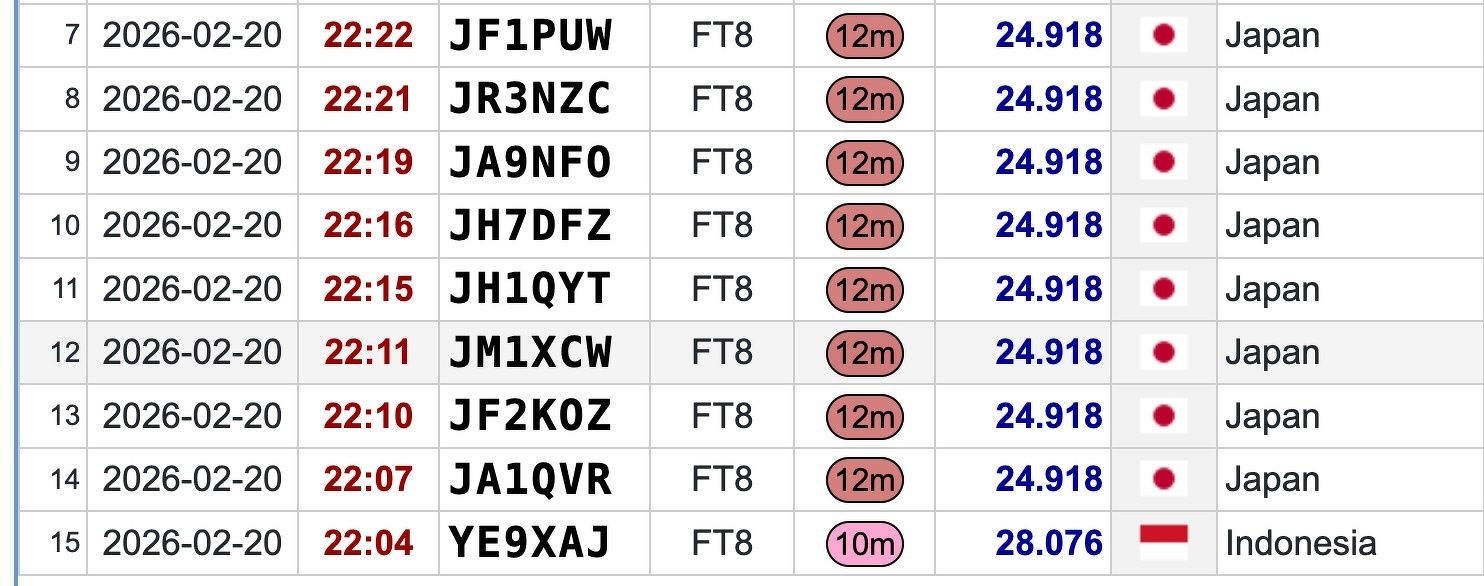
Friday afternoon I tried to cut through the band noise and make a few contacts before it was time to make dinner. The results are in the image at the bottom of the post.
(I’m either an idiot or micro.blog’s image embed feature is not working. If you could see the screenshot I tried to share, it would show eight straight contacts with Japan in a 15-minute run.)
My first Indonesian station followed by a flood of Japanese. All in 20-ish minutes. I flipped over to the phone section of the band but could only catch whispers of JA stations, none loud enough to make a call.
The station that interrupted this run? One from the west side of Indianapolis, less than 20 miles away. Radio is weird sometimes.
Appropriate that this opening came from the Pacific. My first big band opening as a young SWL in the 1980s came on a June morning when, suddenly, stations from Papua New Guinea and Indonesia started popping up all over the Tropical Bands. I had read breathless accounts by old DXers about these mornings, and the joys of chasing the elusive regional stations from those countries. I was finally getting my chance!
A box in our basement holds the logs from that morning. I know I sent off a few reception reports to those stations, none of which earned a QSL reply.
Count that as another vote in favor of modern, digital forms of HF communication: as far as the software is concerned, the contact has been verified. No sending letters to islands thousands of miles away and hoping you might get a reply in a year or so.
Now getting current QSOs verified on QRZ, LOTW, etc. is another story…
Made Man
I was officially voted into one of my local radio clubs last night. It seems like a good group, a mixture of folks both older and younger than me. Which I think is what you want in a club. I’ve always been a learn by reading and doing on my own person. It will be nice to have resources to actually talk to and watch as I prepare to jump into POTA, antenna design, and other areas where just watching a YouTube video might not cut it.
I continue to focus on FT-8. I admit, there is a rush to it, akin to video gaming, when compared to standard voice. It hasn’t helped that I’ve either been busy, the bands have been bad, or the dreaded local noise has made voice difficult for the past week.
As I type this Tuesday morning I’ve added seven new countries in the past 24 hours. Make that eight, another just came through. That quick accumulation of News is just the dopamine rush I need this time of year.
The ability to hit African and Pacific stations is the biggest draw to me. I just do not seem to hear them, or have them hear me on the rare occasions one of them makes it to my QTH, on phone.
The combination of WSJT-X and Gridtracker is a pretty slick interface. Very cool to see where your signal is going and be able to track your stats on the fly.
The Dark Side
I’ve finally dipped my toes into the dark side of the hobby: FT8.
Since I became active last fall I’ve not had any great interest in the digital modes. I want to “talk” to people, even if it is a simple exchange of 59’s and 73’s. That’s how I fell in love with radio, listening to signals that traveled hundreds or even thousands of miles to reach me. With digital, it all seems so disconnected. You click a button, a computer controls your radio, a computer on the other end controls another radio, and so on.
Something about that process does not resonate in my brain. I know lots of ops really enjoy digital but I figured I’d put it off until we get deeper into the bottom of the solar cycle.
After a recent visit with a friend and seeing his setup, I decided to give it a shot. There was the standard set of missteps trying to get everything working. An old Mac plus an IC-7300 can be a tricky combo. Or maybe it’s just my ignorance that was the problem. Once I was able to get a signal out, I wasn’t sure if I was doing things correctly or incorrectly. YouTube to the rescue!
Now, just a couple days later, I’ve nearly worked all states and am starting to rack up some DX contacts.
My verdict? I’m still not sure I get it, nor does it have the same “magic” that voice has. I don’t know if that makes me a curmudgeon or a purist. Hopefully neither, as I have no hostility towards people who are crazy about FT8.
I do enjoy being able to listen to music or watch TV while I operate. Especially on a morning like today, when the bands seem hostile to voice, it gives me an excuse to sit in front of the radio (and computer).
I suppose I’ll stick with it. Perhaps it will interest me more once I know what the hell I’m doing. Or at least have a better idea than I do at the moment.
All Time New Ones
An All Time New One for me today, T77LA in San Marino. He’s on a lot, so not the toughest of catches. But this was the first time I’ve caught him both when he was loud enough I could clearly hear him and there wasn’t a big pile up fighting for his attention. It is always fun to listen for a few minutes, make one call, and get picked up right away.
Lots of good openings to Europe today, although heavy QSB and lots of local noise kept me from adding more than a few new contacts to the logbook.
I’ve reached the point that comes in any hobby where the initial rush is gone plus that first moment where A LOT happens has disappeared. In my first month operating, I collected 10-15 countries. Then when CQ Worldwide rolled around in late October I cleaned up. I added nearly 40 new entities in the two weeks that wrapped around contest weekend.
Since then, on a good week I’ll add a couple. Often I’ll go a seven-to-ten days without any new country boxes checked. That’s going to happen when you’re operating in Indiana with a wire antenna.
I’m not complaining. There are still fun things to do. And I have plenty of time to keep chasing ATNOs.
WWA
A few words about WWA, the contest that’s not a contest, but rather an award.
I chased my share of WWA stations last month. Some days those seemed to be the only non-POTA stations to be found. It felt like I talked to Stuart in New Brunswick daily. That was the one bummer to me: I heard pretty much the same few stations every day. VE9WWA, N1W, CR6WWA, EG3WWA. I did squeeze in a couple new ones the final weekend, 4M5A and YU45MJA.
My white whale of the event were the Dominican stations. I heard them, often loudly, almost every day. But they could never hear me. Friday I spent roughly three hours chasing them on multiple bands with no luck. I know my signals can make it to their island, as I bagged a POTA station activating in the DR in the midst of winter field day. The WWA stations must have been right in an area on the island where my signal skips over.
Ironically I was able to get the closest station, N9W, which was only 52 miles away.
I’m very much a counter when it comes to radio. I want to make contacts and throw them in the log, racking up states, DX entities, etc. that can be added, sorted, and otherwise cataloged. So WWA was very much up my alley. It certainly wasn’t as exciting as a true contest, but it still gave me clear targets to chase each day.
My certificate says 185 points from 37 QSOs across six bands, good for 7197th out of 105,399 entries. It’s not going to get me an invite on to Q5 Ham Radio, but I’m satisfied with it. Even without HI7/HI3.
Searching For Calls
A few days of thinking about radio and doing some rearranging to my “shack.”
Looking back at my dismissed vanity application, it appears that every call I had on my application expired during the government shutdown and received an extension before they officially become available. Each says Expired but remain unavailable on sites like AE7Q. Which explains why all the prediction sites had my first request in Green status. I guess. Kind of annoying, as I have no idea when any of these calls will get final release back into the pool.
So do I sit around and keep waiting, or adjust to another list of calls I’ve put together? I’d rather do something sooner, so I can assign this site to a URL that reflects my actual call. This will stay filed under TBD I guess.
Dismissed
I’m not sure why but my vanity call application was dismissed.
I say I’m not sure why because based on the many tools available online, all but one call on the list I submitted should have been available. Those calls are still available today. And, yes, I hold an Extra class license, so I have sufficient privileges to apply for each of them. I did modify my initial application, so perhaps I messed something up when doing that.
Alas it means I am posting on a website that uses a callsign I do not own. The question is do I jump back into the process, paying the FCC another $35, wait the requisite 20 days, and then hope it works? Or do I just stick with my current call (which is already a vanity call) and adjust accordingly?
I suppose I should be glad I reined in my compulsiveness enough so I didn’t go ahead and buy the domain I had my eyes on. That would have been really dumb.
Winter Field Day
Another snowy weekend, another contest. Or, given it was Winter Field Day, I guess I should say “contest.”
Like the ARRL 10 Meter contest in December, I sat in front of the radio this weekend and racked up contacts while heavy snow fell. We had a basketball game on the calendar before the storm hit, so I had no plans to operate outside the house. When basketball was cancelled, that gave me more radio time. From the comfort of my heated home using full power and an established antenna. Not exactly what the spirit of WFD is all about. But I tend to think any radio “event” is about getting on the bands and making contacts first.
Most of my log entries were 1H like me. Again, probably not what the organizers envisioned, but when you have a massive storm barreling across half the country in January folks are going to stay home.
In the end I submitted 95 contacts. Sadly nothing that will fill in my final three WAS slots. I did land a few Indiana contacts, which are rare for me since I am seldom on 80 at night. I even heard an operator who is 12 miles away from me on 20 Sunday afternoon. He had a good pileup going so I wasn’t able to see if my ground wave was reaching his QTH. I was purely a hunter. One of these days I’ll get confident enough to call CQ during a contest.
Not a bad performance given we had a birthday dinner Saturday evening, a college basketball game to watch, and then spent over three hours outside in multiple shifts getting the 10+ inches of snow cleared away from our driveway.
Storm Watch
I read somewhere this morning that our current geomagnetic storm is the biggest in over 20 years. I have no idea if that is true or not but it is certainly the biggest storm since I became active and has wiped out the HF bands. I made a casual pass this morning and was rewarded with nothing on most bands. There were a few signals on 40 and 80, although there was so much noise there that it wasn’t worth hanging around and attempting to make contact. With a guest in the house this week I haven’t had time to check if there has been any improvement.
Most of the world is oblivious, of course, as satellites and cables wrapped around the earth ensure information gets transferred wherever it is needed. The average American’s only understanding of the storm is a news blurb that the Northern Lights might be visible tonight.
I did wonder about the financial interests that use HF to transmit their data. What a shame it would be if they made a few less dollars today because the sun decided to spew an extra dose of plasma our way…